
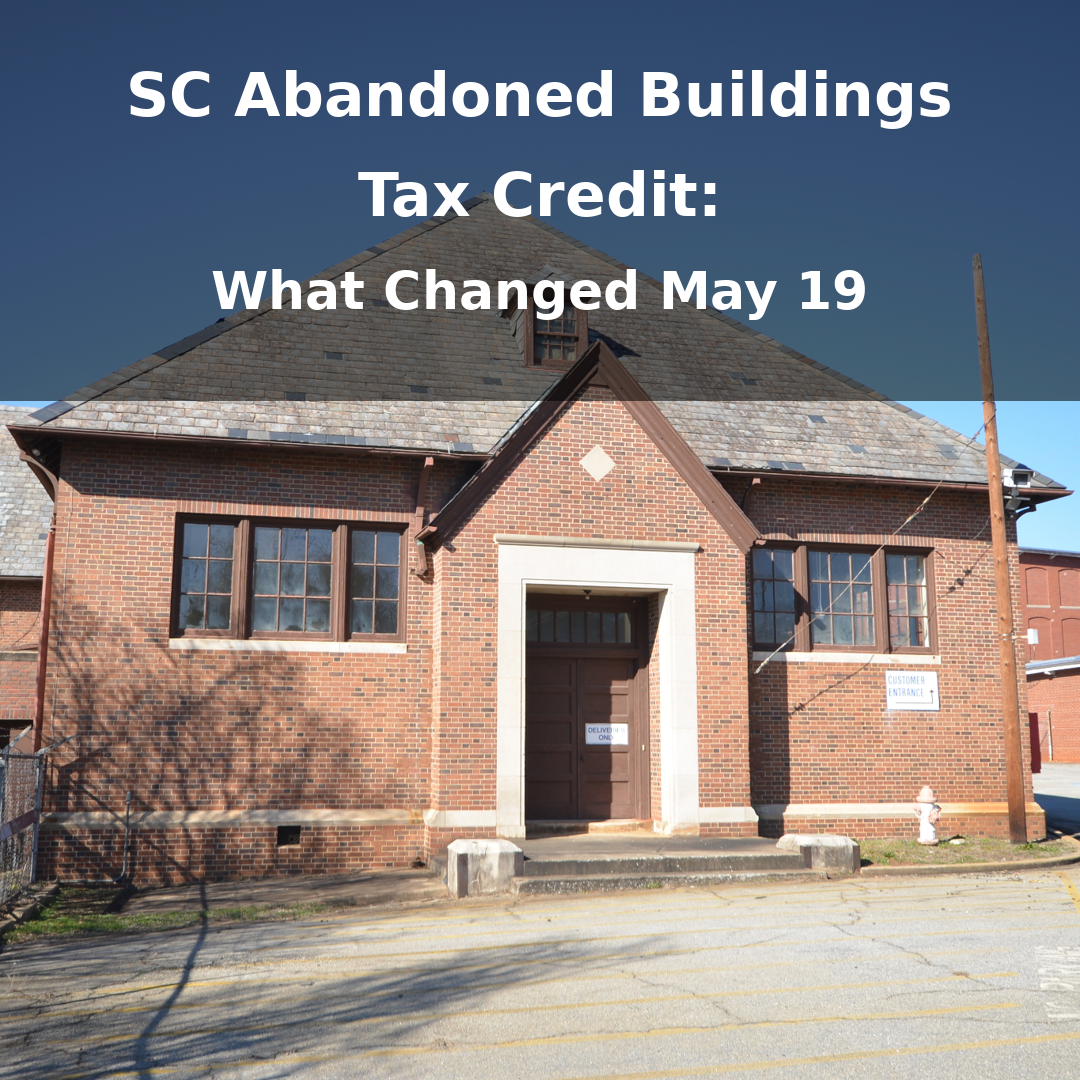
SC Abandoned Buildings Tax Credit: What Changed Under S.853 (May 2026)
Published: May 2026 | Author: The Sherbert Group
On May 19, 2026, Governor McMaster signed S.853 (R.236, Act No. 227) into law, amending South Carolina's Abandoned Buildings Revitalization Act (S.C. Code §§ 12-67-100 et seq.). The amendments are effective immediately and respond directly to interpretive positions taken by SCDOR in Revenue Ruling #26-1 — which itself takes effect June 1, 2026. Where the amended statute and the RR conflict, the statute controls.
Three changes are substantive. Developers and investors with active or pipeline SC abandoned building credit deals should be aware of each.
Eligibility Is Now Broader: Prior Income-Producing Use Not Required
The most significant change is an expansion of the eligible building universe.
Prior law required that the space have been "closed continuously to business or otherwise nonoperational for income producing purposes" for the requisite five-year period. That language implied — and SCDOR's RR #26-1 reinforced — that a building must have had some prior income-producing use before the period of abandonment.
Amended §12-67-120(1) replaces that framing entirely. The test now asks simply whether the space has been "unoccupied continuously or otherwise nonoperational" for five or more years. The bill title states the legislative intent plainly: the existence of a prior income-producing use "is not a requirement for eligibility."
The practical effect is meaningful. Former churches, public schools, government buildings, and community centers that have sat vacant for five or more years now have a clear path to credit eligibility — provided they satisfy the Act's other requirements and will be placed into income-producing use after rehabilitation.
A conforming change to the "building site" definition in §12-67-120(2) removes a related restriction that had limited qualifying land to that associated with the building's prior income-producing use.
NOI Timing Shifts to Building Permit Issuance
Prior §12-67-140(B)(1) required the Notice of Intent to Rehabilitate to be filed before incurring the first rehabilitation expense at the building site. Expenses incurred before the NOI was filed were disqualified.
As amended, the NOI must be filed before obtaining a building permit — not before incurring the first expense. The practical consequence is that pre-permit soft costs — design and engineering fees, environmental assessments, predevelopment legal costs — now qualify as rehabilitation expenses, provided the NOI is filed before the building permit issues.
Credit Collateralization Is Prohibited
New §12-67-140(B)(5)(c) provides that a taxpayer may not pledge, assign, hypothecate, or otherwise collateralize any portion of the credit as security for debt.
Standard bridge financing structures used in SC tax credit deals — which take collateral on equity installment receivables, project entity interests, and real property rather than the credit itself — are unaffected by this prohibition.
Effective Date and the RR #26-1 Window
The Act is effective May 19, 2026. Revenue Ruling #26-1 applies to NOIs filed on or after June 1, 2026.
NOIs filed between May 19 and May 31 are governed by the amended statute but pre-RR #26-1 administrative guidance — generally the more favorable window for developers. For NOIs filed on or after June 1, both the amended statute and RR #26-1 apply; where they conflict, the statute controls.
Full Bill Text
S.853 is available on the SC Legislature's website: scstatehouse.gov/sess126_2025-2026/bills/853.htm
Questions about how these amendments affect a deal in your pipeline? Contact The Sherbert Group at info@sherbertgroup.com.