
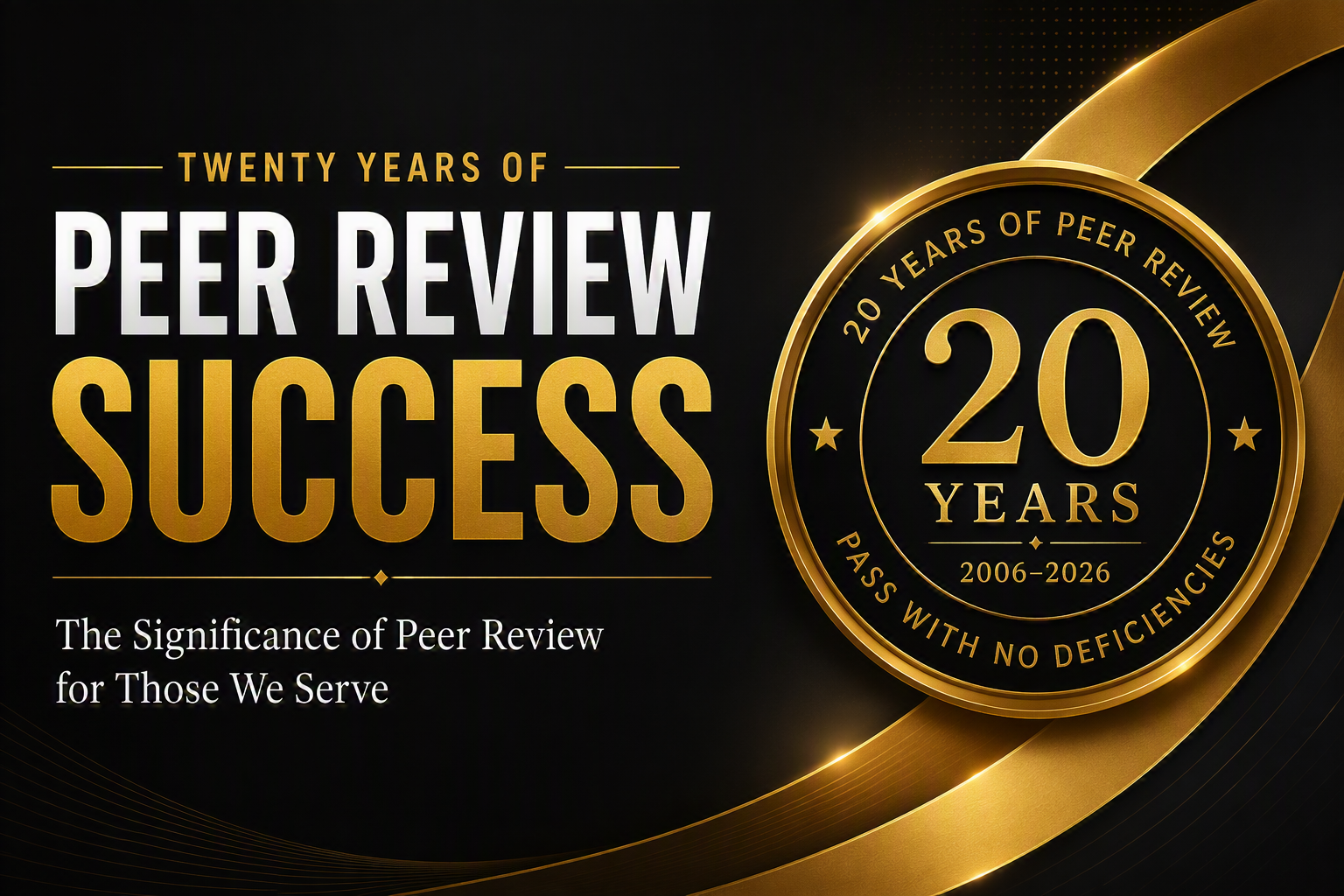
Twenty Years of Peer Review Success:
The Significance of Peer Review for Those We Serve
By Chris Saunders, Audit Director, Sherbert CPA, PC csaunders@sherbertcpa.com
This year marks the twentieth anniversary of Sherbert CPA, PC. Since our founding in 2006, our firm has completed every required peer review, and on each occasion, we have received a rating of pass with no deficiencies. We believe this record deserves the attention of those who engage us. Our purpose in addressing this achievement is not self-commendation; rather, it is to acknowledge that many clients are unfamiliar with the peer review process. When you understand what peer review entails and what an unblemished record signifies, you learn something meaningful about the CPA firm you have entrusted with your important work.
The Nature of Peer Review
Peer review is a mandatory program of quality oversight administered by the American Institute of Certified Public Accountants (AICPA) and the state CPA societies. It governs every CPA practice that performs audit, review, compilation, or other attest engagements. Its purpose is to confirm that CPA firms adhere to professional standards and that the public may rely upon the work those firms produce. Participation is neither voluntary nor self-reported. An independent and qualified reviewer, wholly unaffiliated with the firm under examination, evaluates the firm’s work and reports the results.
The Conduct of the CPA Peer Review
Every three years, a peer reviewer undertakes a thorough examination of Sherbert CPA, PC. This examination encompasses the following:
- An examination of selected engagement files drawn from the firm’s audit and attest practice
- An evaluation of the firm’s system of quality control, comprising the policies and procedures that govern the manner in which engagements are planned, performed, documented, and supervised
The reviewer assesses our firm’s compliance with the professional standards applicable to our practice:
- GAAS (Generally Accepted Auditing Standards) are the standards that govern audit engagements
- GAGAS (Generally Accepted Government Auditing Standards) are the standards that govern engagements performed under the HUD Consolidated Audit Guide
- SSARS (Statements on Standards for Accounting and Review Services) are the standards governing review and compilation engagements
- SSAE (Statements on Standards for Attestation Engagements) are the standards governing other attestation work
Upon completion of the peer review, the CPA firm receives one of three ratings:
- Pass – the firm’s system of quality control and its selected engagements satisfy professional standards
- Pass with Deficiencies – isolated matters were identified, and the firm is required to undertake corrective action
- Fail – significant and systemic deficiencies exist, the consequences of which may include the loss of AICPA membership and of the authority to perform attest engagements
The results of each review are reported to the applicable state CPA society and constitute a matter of public record.
The Practical Importance of These Ratings
A rating of pass is not a mere formality. It signifies that an independent professional has examined our team’s actual work and has concluded that it meets the standards the profession demands. A rating of pass with deficiencies indicates that problems were identified, notwithstanding their subsequent resolution. A rating of fail is a grave matter that reflects a breakdown in the firm’s system of quality control and can place clients at risk.
The Significance of Peer Review in Specialized Engagements
Sherbert CPA, PC devotes itself exclusively to audit and attest engagements that bear direct financial consequence for our clients:
- Audits of financial statements
- Audits of federal and state historic tax credit cost certifications – required documentation for claiming Historic Tax Credits on qualified rehabilitation projects
- Audits of mill credits – state-level tax credit programs
- Audits of LIHTC cost certifications – required for Low Income Housing Tax Credit projects to establish eligible basis and calculate the final credit amount
- Audits of 10% Test Carryover Allocation – required documentation demonstrating that at least 10% of a project’s reasonably expected basis has been incurred, preserving a project’s LIHTC allocation during construction
In engagements involving tax credit audits, peer review deficiencies or failures may precipitate credit recapture, delay a closing, jeopardize a tax credit allocation, or have other negative client consequences. Peer reviews with no deficiencies affirms that our systems of quality control are structured to guard against such negative outcomes.
Our Record and Our Commitment in the Years to Come
Twenty years with a peer review rating of pass with no deficiencies is not just a milestone, it is a standard we have resolved to uphold. We are deeply grateful to the clients who have shared in Sherbert CPA, PC’s first twenty years, and we look toward the next twenty with the same dedication, culture of quality control, commitment to training, and to continue providing premier services and advice to our valued clients in the real estate tax credit industry.
Final Thoughts
Peer review results are publicly searchable through the AICPA’s peer review public file at aicpa.org. In evaluating any CPA firm, two questions deserve consideration: When was the firm’s most recent peer review, and what was its result? The answers to these questions reveal far more than any promotional material could convey.
Find us at: https://www.sherbertcpa.com/