Is Your HUD-Assisted Property Ready for HUD’s New Inspection Standard? Here’s What Every Owner Needs to Know About NSPIRE
By Nidhi Thakkar, Audit Manager, Sherbert CPA, PC, nthakkar@sherbertcpa.com
If you own or manage a HUD-assisted property, there’s a significant regulatory shift underway that deserves your full attention and the clock is ticking.
HUD has replaced its decades-old physical inspection framework with a new model called NSPIRE, the National Standards for the Physical Inspection of Real Estate. This isn’t just a new checklist. It’s a fundamentally different way of evaluating your property, and non-compliance can put your HUD assistance and program standing at risk.
At Sherbert CPA, we’ve been tracking this closely as part of our real estate audit practice. Here’s what you need to know, broken out by program, since the rules and deadlines are not the same across HUD programs.
What Is NSPIRE, and Which HUD Programs Does It Apply To?
If your property participates in a HUD-assisted program, NSPIRE governs your physical inspection standard. NSPIRE standards have been in effect and scored for Public Housing since July 1, 2023, and for Multifamily since October 1, 2023 except for Multifamily properties that participated in the NSPIRE Demonstration, which began July 1, 2023 (unless they opted out by March 1, 2023, in which case they received a UPCS inspection instead). Housing Choice Voucher (HCV), Project-Based Voucher (PBV), and Section 8 Moderate Rehabilitation properties move to NSPIRE-V (a pass/fail model with no score) by February 1, 2027. HOME and Housing Trust Fund properties must comply by April 14, 2027. Confirm your specific effective date with your HUD contact or monitoring agency.
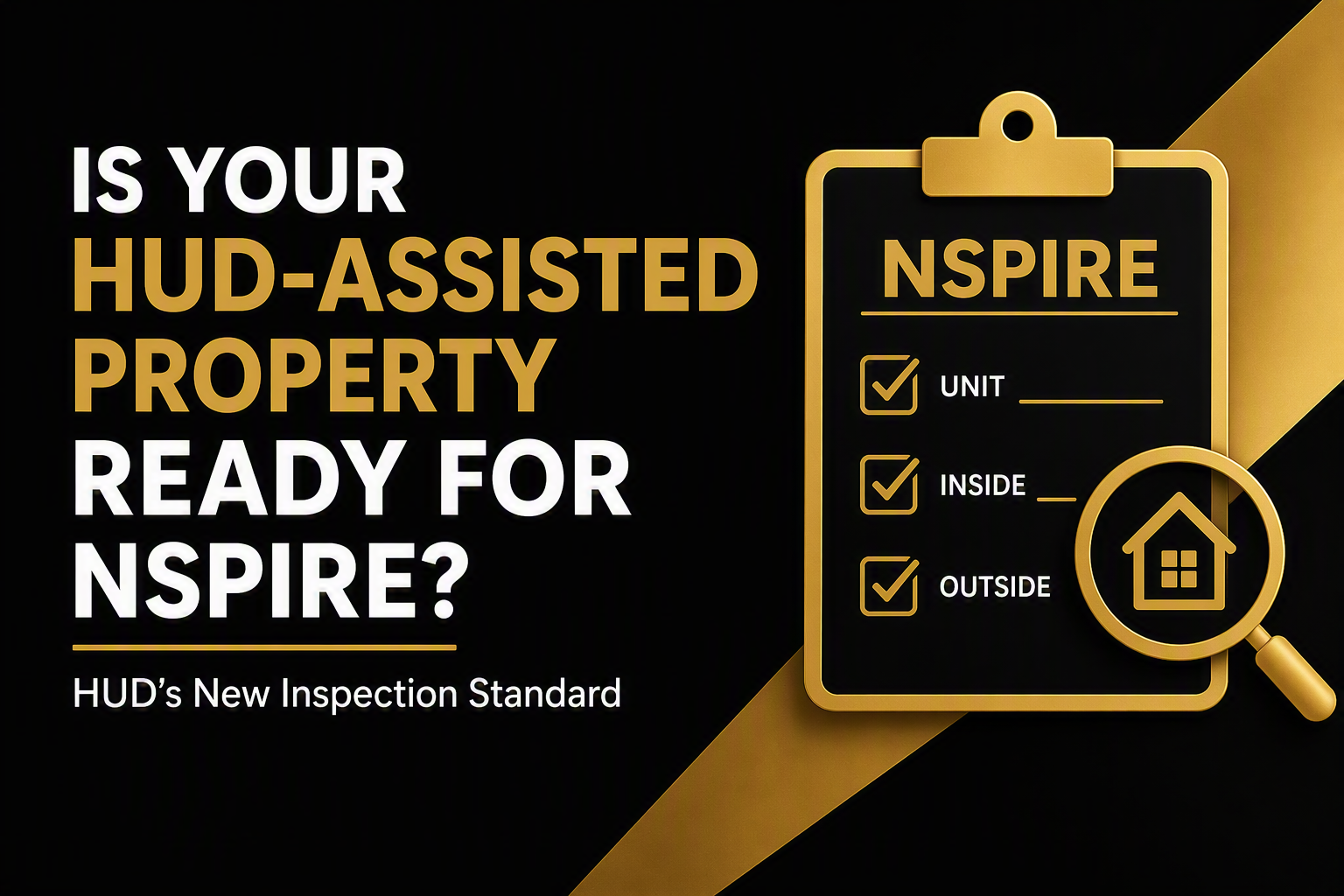
NSPIRE organizes inspections into three areas: Unit, Inside, and Outside with Affirmative Requirements in each.
Severity Tiers and Correction Timelines -Public Housing / Multifamily
PH and Multifamily properties are scored, and deficiencies carry the correction windows shown in the table below. Scores run 0–100; a score below 60 is a failing inspection, and 30 or more points of deductions from the Unit area alone can fail a property regardless of total score.
| Severity | Examples | Correction Deadline |
| Life-Threatening | Blocked egress, exposed wiring, inoperable heating during heating season | 24 hours (evidence to HUD within 2 business days) |
| Severe | Major water intrusion, structural defects | 24 hours (evidence to HUD within 2 business days) |
| Moderate | Damaged surfaces, minor plumbing | 30 days |
| Low | Minor cosmetic issues | 60 days |
This information is illustrative and the owners should refer to HUD guidance for their specific properties.
Note: the 24-hour clock is the correction deadline and begins immediately upon notification, including weekends and non-working hours. Evidence of correction for Life-Threatening and Severe items is due to HUD separately, within 2 business days.
Severity Tiers - HCV / PBV / Mod Rehab (Pass/Fail - No Score)
These programs use NSPIRE-V, a pass/fail inspection with its own, longer timeframe for Severe deficiencies. There is no numeric score in this track.
| Result | Examples | Correction Deadline |
| Fail — Life-Threatening | No smoke/CO detector, blocked egress, inoperable heating during heating season | 24 hours |
| Fail — Severe | Major water intrusion, structural defects | 30 days |
| Fail — Moderate | Damaged surfaces, minor plumbing | 30 days |
| Pass — Low | Minor cosmetic issues | No action tracked (pass/fail — no score) |
This information is illustrative and the owners should refer to HUD guidance for their specific properties.
NSPIRE HVAC Standard
The HVAC standard does not use a fixed indoor temperature threshold. It keys off outside temperature: if the outside temperature is below 68°F and the unit cannot maintain a minimum of 68°F through a safe heating source, that is Life-Threatening and must be corrected within 24 hours. If the outside temperature is 68°F or above and the unit still cannot maintain 68°F, that is a 30-day correction. Loss of heat during the heating season is treated as Life-Threatening, not Severe.
Six Items That Aren’t Being Scored Yet - But Will Be Soon
HUD is in a phase-in period for what it calls Affirmative Requirements. Six categories are currently inspected and cited, but not yet scored:
- Fire-Labeled Doors
- Electrical GFCI or Arc Fault Circuit Interrupter (AFCI)
- Guardrails
- HVAC
- Interior Lighting
- Minimum Electrical and Lighting
Important: “not scored” does not mean “not cited.” Deficiencies in these six categories are still recorded at inspection today and must still be corrected within the applicable severity timeframe. Full scoring for these categories begins October 1, 2026, for Public Housing and Multifamily properties.
That date is not far away. If your property has deferred any of these items, now is the window to get ahead of it and not after your next inspection.
A caution on fire doors: the phase-in covers the affirmative requirement that rated openings carry a labeled fire door. A fire-rated door that is damaged, propped, missing, or will not self-close and latch is cited under the Door standard and is scored today. At a Sherbert Group HUD property inspection in May 2026, three fire-rated door deficiencies (one Life-Threatening, two Severe) were scored, and HUD counted each location separately rather than consolidating them. The property still finished with a score of 97, but those three items carried 24-hour correction clocks and a two-business-day evidence deadline.
Key Compliance Dates at a Glance
| Program | Key Date | What Happens |
| Public Housing | July 1, 2023 | NSPIRE effective and scored |
| Multifamily | October 1, 2023 | NSPIRE effective and scored |
| Public Housing / Multifamily | October 1, 2026 | Affirmative-requirement scoring begins |
| Housing Choice Voucher / Project-Based Voucher | February 1, 2027 | NSPIRE-V compliance required (pass/fail — no score) |
| Section 8 Mod Rehab | February 1, 2027 | NSPIRE-V compliance required (pass/fail — no score) |
| HOME / Housing Trust Fund | April 14, 2027 | Full compliance required |
Does NSPIRE Apply to LIHTC Properties?
NSPIRE is a HUD physical inspection standard, not a Section 42 requirement. A LIHTC property is only reached by NSPIRE if it also carries a HUD-assisted overlay (such as Section 8 HAP, PBV, or HOME/HTF funding) or if the state Housing Finance Agency has adopted NSPIRE in its Qualified Allocation Plan or compliance monitoring protocol. If neither applies, confirm with your HFA which physical inspection standard currently governs your property.
Things to Do Now
- Pull your last inspection report. Confirm which program track applies (scored vs. pass/fail) and that all Life-Threatening and Severe items were corrected on time, with evidence submitted where required.
- Check your Reserve for Replacement. Severe and Moderate findings should be reflected in your capital plan.
- Verify which compliance date applies to your program. Different HUD programs have different NSPIRE effective and scoring dates. Confirm with your HUD or Housing Finance Agency (HFA) contact which deadline governs your property.
- Have your Lead-Based Paint file ready. Inspectors request the LBP inspection report or exemption documentation on site. A pre-1978 property with a completed abatement and clearance report can still be flagged as "not provided/expired" if the close-out documentation is not in the HUD file; a property that used encapsulation or interim controls is not exempt and needs ongoing reevaluation records (24 CFR 35.115, 35.1355).
- Retrieve the itemized deficiency detail promptly. The scored report can arrive with the per-item detail (deficiency names, comments, photos, point values) blank. Pull the itemized records from the NSPIRE portal links in the inspection notification while they are live and retain them for the compliance and due-diligence file.
- Know which score is the score of record. Your report may show both a projected score and a final score (for example, 96 projected and 97 final at a Sherbert Group property this year). Confirm which HUD is carrying before you report it to lenders or investors.
- Important: Unresolved physical condition non-compliance is one of the most common triggers for HUD enforcement action, contract termination, or non-compliance reporting. Don’t wait until your next inspection to address open items.
How Sherbert CPA Can Help
Our real estate audit practice specializes in affordable housing, and we’re here to help you navigate NSPIRE’s impact on your HUD-assisted property from understanding inspection reports and open CAPs to program compliance exposure and reserve adequacy.
If you have questions about how NSPIRE affects your property, your upcoming audit, or your compliance standing, we’d encourage you to reach out.
Sources
This article relies on the following primary sources. Deadlines under NSPIRE have been extended several times; confirm current dates before acting.
- U.S. Dep't of Housing & Urban Dev., Implementation of National Standards for the Physical Inspection of Real Estate (NSPIRE) Administrative Procedures, Notice PIH 2023-16 / H 2023-07 (June 30, 2023) — hud.gov
- U.S. Dep't of Housing & Urban Dev., Revised Compliance Date for National Standards for the Physical Inspection of Real Estate (NSPIRE) New Affirmative Requirements, Notice PIH 2025-27 / H 2025-06 (Sept. 30, 2025) — hud.gov
- U.S. Dep't of Housing & Urban Dev., NSPIRE Standard — HVAC, v2.1 — hud.gov
- U.S. Dep't of Housing & Urban Dev., NSPIRE Opt-Out FAQ (2023) — hud.gov
- Extension of NSPIRE Compliance Date for Housing Choice Voucher, Project-Based Voucher, and Section 8 Moderate Rehabilitation Programs, 90 Fed. Reg. 46,911 (Sept. 30, 2025) — federalregister.gov
- National Standards for the Physical Inspection of Real Estate: Implementation Guidance and Inspection Standards for the HOME Investment Partnerships and Housing Trust Fund Programs, 91 Fed. Reg. 19,145 (Apr. 14, 2026) — federalregister.gov
- Treas. Reg. § 1.42-5 (compliance monitoring; physical inspection requirements) — ecfr.gov
For HUD's full index of NSPIRE notices and standards, see NSPIRE Official Notices and Proposed Rules and NSPIRE Standards.
Last updated: August 21, 2026. This article is provided for general information and is not tax, legal, or compliance advice.